



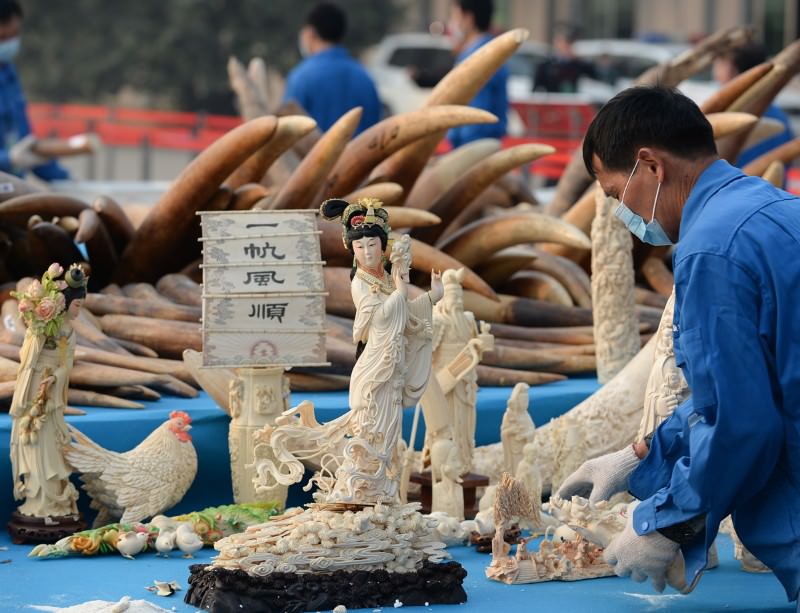
China steps up efforts to combat ivory smuggling
The headline-grabbing haul came from about 700 slaughtered elephants. That is a fraction of the estimated 22,000 animals killed annually in Africa, more than half of which end up in the Chinese market. The Chinese authorities are now responding to international pressure to act against the illegal trade, says Tom Milliken of TRAFFIC in Cambridge, UK, which monitors the wildlife trade. Last year, eight Chinese smugglers were imprisoned for up to 15 years. And this week’s ivory crushing had wide coverage in Chinese media.
“The ivory destroyed included Chinese figurines and sculpture, Buddhist rosaries and Canton magic balls,” says Milliken. “The images will have a powerful impact in a country where the government still shapes public opinion.” They need to. China has a voracious demand for carved ivory products, which are viewed as high-value status symbols by its growing middle class. As a result, elephant poaching in Africa is currently at a 20-year high, reversing the downward trend that followed a worldwide ban on the ivory trade introduced in 1989 by the UN Convention on International Trade in Endangered Species (CITES).
Related Posts

Tobacco smuggling: MPs criticise ‘lack of action’
Efforts to tackle tobacco smuggling have been hampered by a "farcical" lack of...
16 detained in gold smuggling case
Customs authorities have detained 16 people in east China's Fujian Province in...

Law banning ’crackers seen boost to smuggling
BOCAUE, Bulacan—As expected, the industry that profits from fireworks and...
Hong Kong Customs smashes suspected smuggling case of electronic products at Shenzhen Bay Control Point
Hong Kong (HKSAR) - Hong Kong Customs today (September 20) seized a large haul of...