



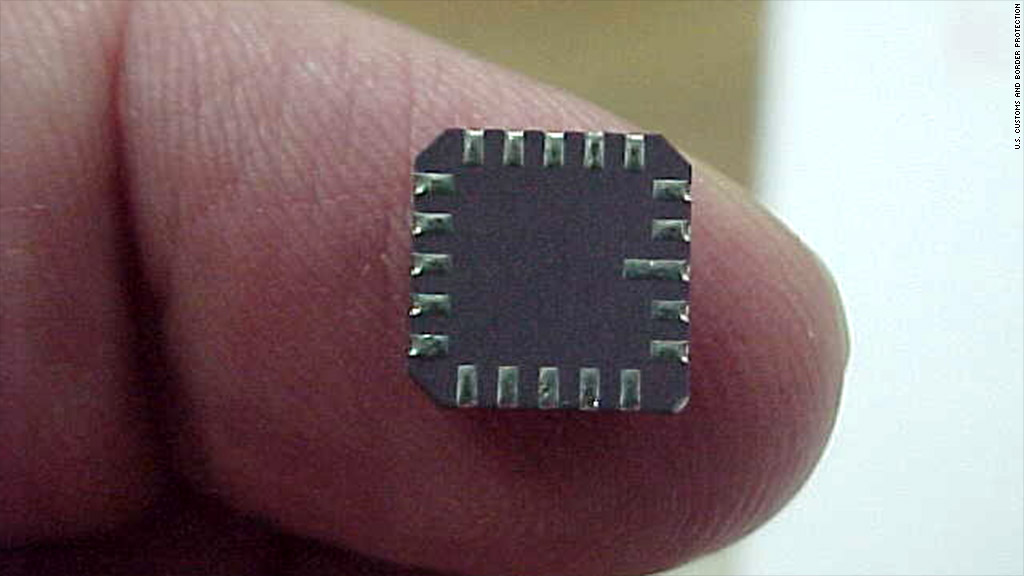
Fake tech gear has infiltrated the U.S. government
This counterfeit microchip for military use was seized by U.S. Customs and Border Protection. It’s one of a growing number of fake tech products inadvertently bought by the government. A record number of tech products used by the U.S. military and dozens of other federal agencies are fake. That opens up a myriad of national security risks, from dud missiles to short-circuiting airplane parts to cyber espionage. Despite laws designed to crack down on counterfeiters, suppliers labeled by the U.S. government as “high risk” are increasing their sales to federal agencies. Their presence in government’s supply chain soared 63% over the past decade, according to a new study released by IHS, a supply chain management consultancy. Suppliers with the high-risk branding are known to engage in counterfeiting, wire fraud, product tampering and a laundry list of other illicit and illegal behaviors. Last year, 9,539 banned businesses were found to have sold technology the government. Roughly 10% of those incidents involved counterfeit parts or equipment.”What keeps us up at night is the dynamic nature of this threat, because by the time we’ve figured out how to test for these counterfeits, they’ve figured out how to get around it,” said Vivek Kamath, formerly the head of Raytheon’s (RTN, Fortune 500) supply chain operations. “It’s literally on almost a daily basis they change. The sophistication of the counterfeiting is amazing to us.”The number of fake tech products floating around in the market quadrupled from 2009 to 2011, according to IHS — and they’re sneaking into some high-profile places. In September 2010, the Missile Defense Agency found that the memory in a high-altitude missile’s mission computer was counterfeit. Fixing the problem cost $2.7 million. Had the bomb launched, it most likely would have failed, the agency said. Two years earlier, the FBI seized $76 million of counterfeit Cisco (CSCO, Fortune 500) routers that the Bureau said could have provided Chinese hackers a backdoor into U.S. government networks. A number of government agencies bought the routers from an authorized Cisco vendor, but that legitimate vendor purchased the routers from a high-risk Chinese supplier. China continues to be the largest source for counterfeit and pirated goods found in the United States, accounting for 62% of the $178 million in products (with an estimated retail value of $1.1 billion) that the U.S. Customs and Border Protection agency seized last year. Some in Congress have pushed for a crackdown.”Counterfeit parts pose an increasing risk to our national security, to the reliability of our weapons systems and to the safety of our men and women in uniform,” Sen. John McCain, a Republican from Arizona, said last year in support of anti-counterfeiting regulations.
http://money.cnn.com/2012/11/08/technology/security/counterfeit-tech/
Related Posts
Tanzania to make public statistics on counterfeit mobile phone
The Tanzania Communications Regulatory Authority (TCRA) said on Sunday it will...

30% FMCG items fake, counterfeit auto parts cause of 20% accidents: FICCI
FICCI CASCADE, the industry body working on addressing unlawful trade activities...
Research and Markets: Anti-counterfeit and Brand Protection – Luxury Products, Beauty Products and Apparel: Potential Synergies in Shared Marketing and Distribution
The landscape for the brand protection business has been evolving substantially...
Irishman sentenced in UK for illegally importing cigarettes.
An Irishman who was convicted of illegally importing cigarettes into the UK has...